
This is Part V of a series of articles to explain the basics of BaZi to beginners and get readers started on understanding their own destiny.
Part I: The BaZi Chart, Your Life’s Source Code
Part II: Yin, Yang, and the Five Element Cycle (Wu Xing)
Part III: The Alphabet of Destiny – Stems & Branches
Part IV: The Day Master & The 10 Gods
Over the last four articles, we have built an understanding of the complete engine of your BaZi chart. We mapped the dashboard (the Palaces), learned the physics engine (the Five Elements), translated the alphabet (the Stems and Branches), and identified your inner team (the Day Master and 10 Gods).
But your Natal Chart is entirely static. It is a snapshot of the exact moment you were born. It shows your capacity, your psychology, and your baseline stats, but it doesn’t tell you when things are going to happen.
A static chart cannot explain why an entrepreneur struggles for a decade, then suddenly builds a multi-million-dollar empire in two years. To understand the events of your life, we have to introduce the final dimension: Time.
In classical BaZi, time is not just a measurement; it is an active, kinetic force. To understand how to strategize your future, you need to understand the difference between your base stats, the current campaign setting, and the Dungeon Master’s (DM) random encounters.
1. The Character Sheet: Your Natal Chart (四柱)
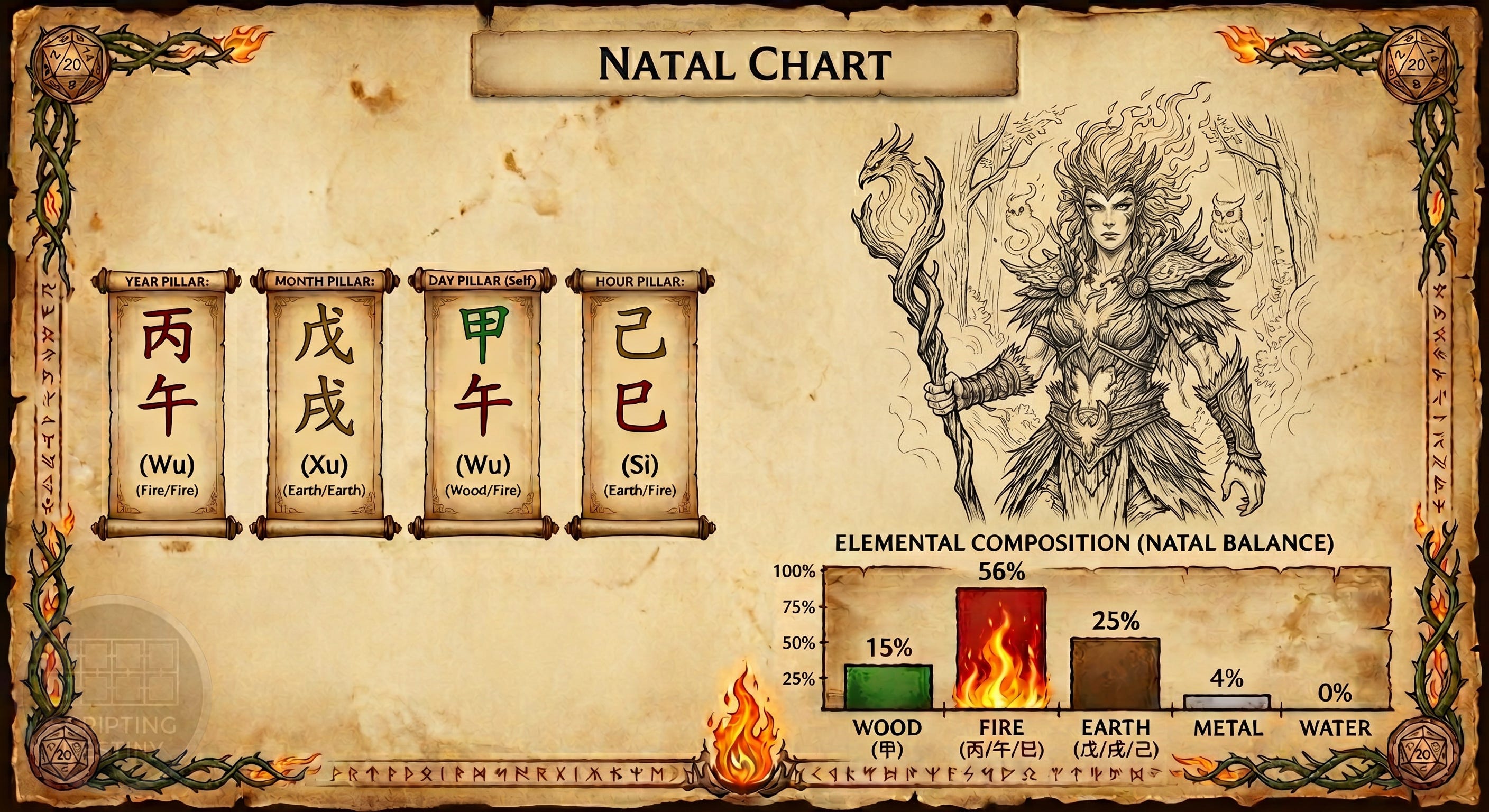
Your Natal Chart (the Year, Month, Day, and Hour pillars) is your core Character Sheet with your base stats. It is the build you rolled at birth, and it does not change mid-game.
If your chart has a powerful “Seven Killings” structure, you are built like a frontline Berserker or Tank - designed to thrive in combat, handle massive aggro, and create order out of chaos. If you have an “Eating God” structure, you are built like a high-Intelligence Mage or Bard - designed for strategy, utility, refinement, and backline execution.
You cannot re-roll your character sheet. But whether your specific build ever utilizes its maximum potential depends entirely on the campaign setting you are forced to play in.
2. The Campaign Modules: The 10-Year Luck Pillars (大运)
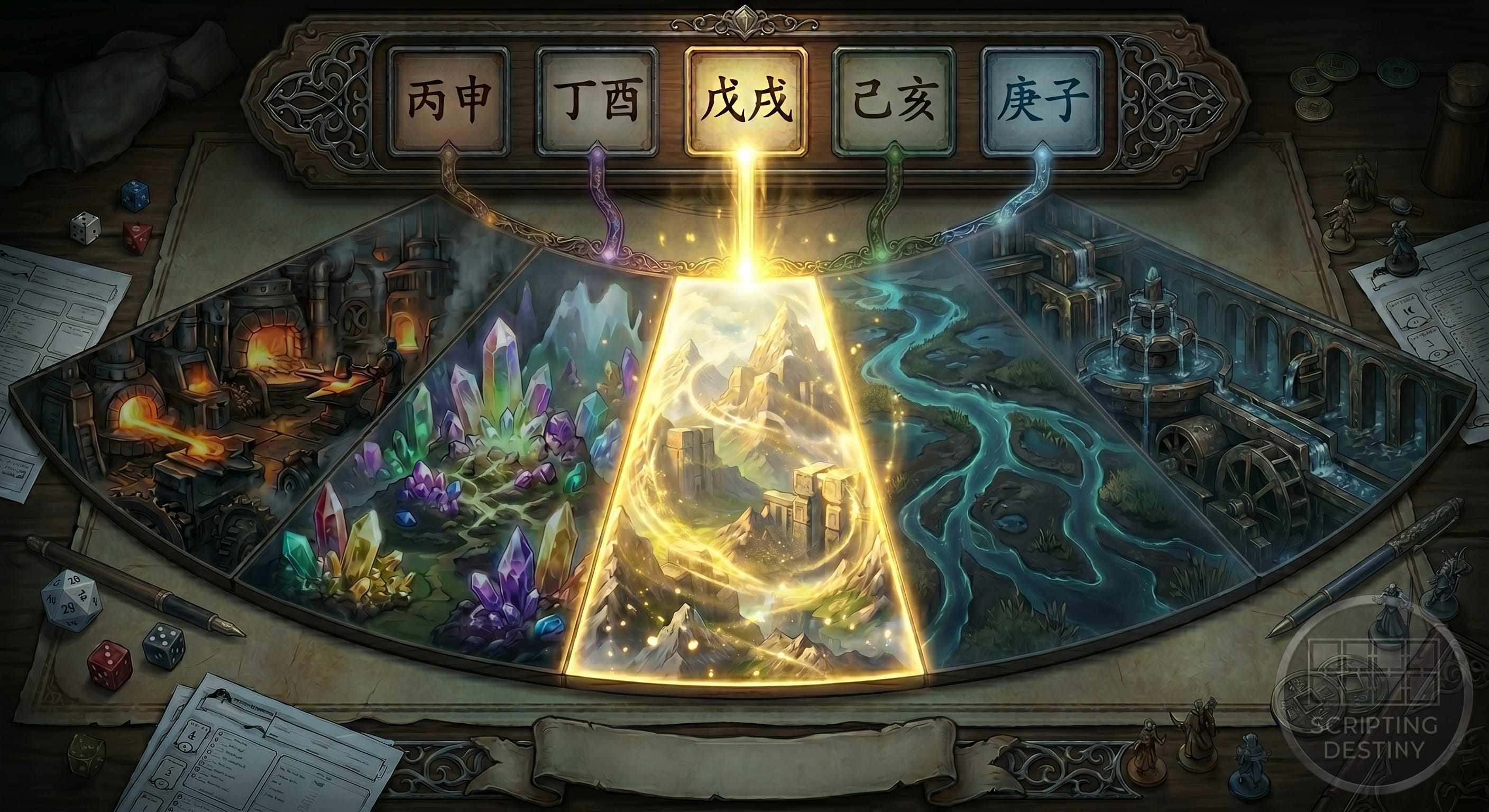
When you generate your BaZi chart, you will see a section at the bottom broken into 10-year blocks. These are the Da Yun (大运), commonly translated as “Luck Pillars.”
Let’s clear up a massive mistranslation: “Luck” here does not mean rolling a natural 20. The character Yun (运) literally means movement, transport, or cycle. These are your Major Campaign Modules, and the universe is the DM determining what they are and when you’ll have to adventure through them.
The 10-Year Luck Pillars represent the macro-environment - the overarching storyline and biome you will be navigating for an entire decade. Every ten years, the “meta” of your life shifts. A new Heavenly Stem and Earthly Branch arrive, bringing new 10 Gods into your reality and changing the rules of the board.
The Favorable Module (The Buff): If your specific character build desperately needs Fire to be balanced (your Useful God), you aren't a Fire Mage - you’re a Solar Paladin who spawned with zero mana regeneration. When you enter a 10-year Fire Luck Pillar, you finally step out of the dark and into a sun-drenched biome. The environment is now providing the exact resource your build was missing. Your stats are passively buffed. Your decisions naturally yield critical hits, you finally have the mana to cast your ultimate abilities, and you level up rapidly.
The Hostile Module (The Nerf): What if that same Solar Paladin rolls a 10-year Luck Pillar made entirely of heavy, restrictive Water elements? The DM just dropped you into a massive underwater dungeon. The environment is actively suppressing your core mechanics and draining your light. It doesn’t mean a guaranteed game over, but it does mean your primary offensive stats are severely nerfed. You cannot rush headfirst into combat. You have to switch tactics, lean heavily on your party, farm resources safely, and play a strict defensive survival game until the campaign shifts.
3. The Random Encounters: The Annual Pillar (流年)

If the Luck Pillar is the 10-year campaign setting, the Annual Pillar (流年 - Liu Nian, literally “Flowing Year”) is the Dungeon Master throwing a set encounter at the table.
The Annual Pillar applies to everyone on Earth. For example, 2024 is the Year of the Wood Dragon (Jia Chen). 2025 is the Year of the Wood Snake (Yi Si). The Annual Pillar interacts with your specific character sheet and your specific campaign module to create a unique outcome.
How it triggers events: The Annual Pillar acts as the catalyst. You might be playing in a fantastic 10-Year Campaign (a highly favorable module), but if the Annual Pillar brings a clash to your chart, you may walk into a sudden boss fight or trap. You might take some HP damage, lose some gold, or face a temporary debuff, but because the broader campaign setting supports your build, you heal and recover quickly.
Conversely, if you are struggling through a hostile 10-Year module and a terrible Annual Pillar arrives, that random encounter can easily cause a party wipe. You could lose everything and have to start over if you aren’t prepared.
Annual Pillars can also bring fortuitous encounters if they are favourable to your chart. You might experience the equivalent of finding treasure in unexpected places, rolling a nat 20 on whatever you do or simply find that the difficult terrain you’ve been navigating is now easier to traverse.
While a Luck Pillar may represent the overall theme or terrain for the decade, your lived experience during that decade is more influenced by the annual pillar.
The Targeting System: How We Forecast
This is exactly why BaZi is not vague fortune-telling. When I write about the upcoming year or month, I am essentially reading the universe’s campaign notes to see what is coming and how it targets the static Palaces on your character sheet.
Because the elements are systematic, we can track the DM’s math.
If the incoming Annual Pillar clashes with your Month Pillar, we know the encounter is targeting your Career. We forecast job changes, office politics, or issues with superiors.
If the incoming Pillar combines with your Day Pillar, the encounter is targeting you or your relationship with your spouse. We forecast new romantic relationships, relationship issues, or shifts in your home life.
The Strategist’s Mindset
By understanding the Matrix of Time, you stop being an NPC at the mercy of the plot and become a min-maxing player of your own life.
If you know a severe encounter is targeting your Career Palace next year, you do not rage-quit your job. You pre-buff. You upskill, you avoid risky aggro in the office, and you play defensively until the event passes.
If you know a massive 10-year favorable Campaign is starting, you take the calculated risks you’ve been putting off, because you know the board is finally optimized for your specific class.
BaZi is the ultimate life strategy guide. You cannot stop the universe from switching things up, but knowing what lies ahead allows you to equip the right gear for that phase of your journey.
Author’s Note: This concludes the foundational series establishing a shared language for understanding the mechanics of destiny via this blog.
You now have the core vocabulary needed to read my regular forecasts, decode your base stats, and understand the mechanics of BaZi.
For those who want to look deeper - who want to understand the hidden sub-code of their chart, diagnose exactly which elements are secretly sabotaging them, and learn the advanced mechanics of chart structures - the journey continues in the premium subscription tier.
Enjoyed the article? Journey with me, get access to special case studies of how destiny manifests in real life, and learn to script your own destiny.
Disclaimer: Scripting Destiny explores classical BaZi as a structural framework for personal strategy. The content provided here is strictly for informational and educational purposes, and does not constitute professional financial, medical, or legal advice. You are the SysAdmin of your own life; make your decisions accordingly.