
This is Part III of a series of articles to explain the basics of BaZi to beginners and get readers started on understanding their own destiny.
Part I: The BaZi Chart, Your Life’s Source Code
Part II: Yin, Yang, and the Five Element Cycle (Wu Xing)
Part IV: The Day Master & The 10 Gods
Part V: The Matrix of Time – Luck Pillars & Annual Pillars
In Part I of this series, we mapped out the “UI” dashboard of your BaZi chart - the rows and columns that dictate the different areas of your life. In Part II, we looked under the hood to understand the physics engine powering it all: Yin, Yang, and the Five Elements.
But if you actually generate your BaZi chart, you won’t just see the words “Yang Fire” or “Yin Water” neatly printed in English. You will see a grid of specific Chinese characters.
To read the code, you need to know the alphabet.
In BaZi, this alphabet consists of 22 characters: the 10 Heavenly Stems and the 12 Earthly Branches. Let’s decode them.
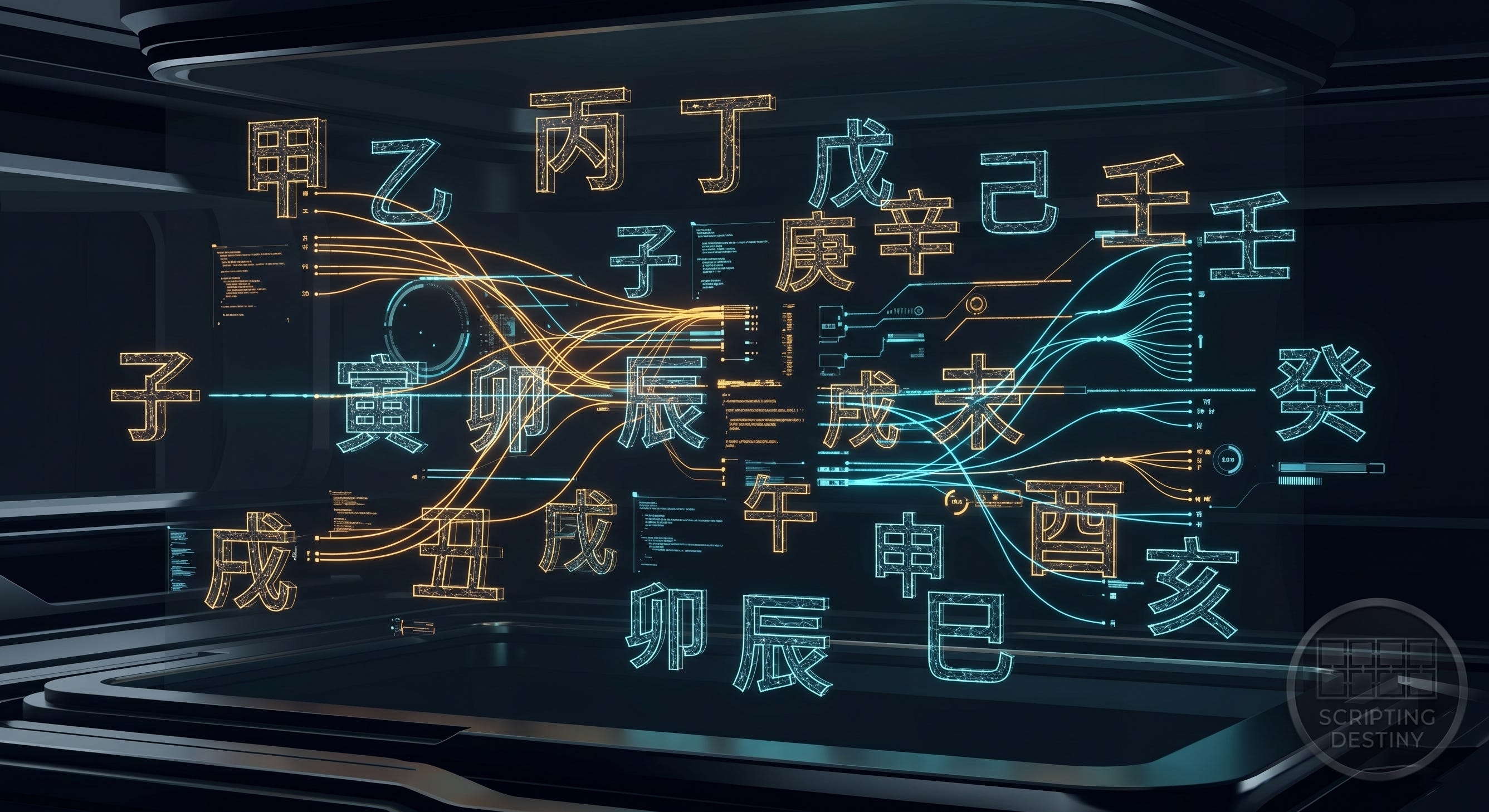
The Surface Variables: The 10 Heavenly Stems
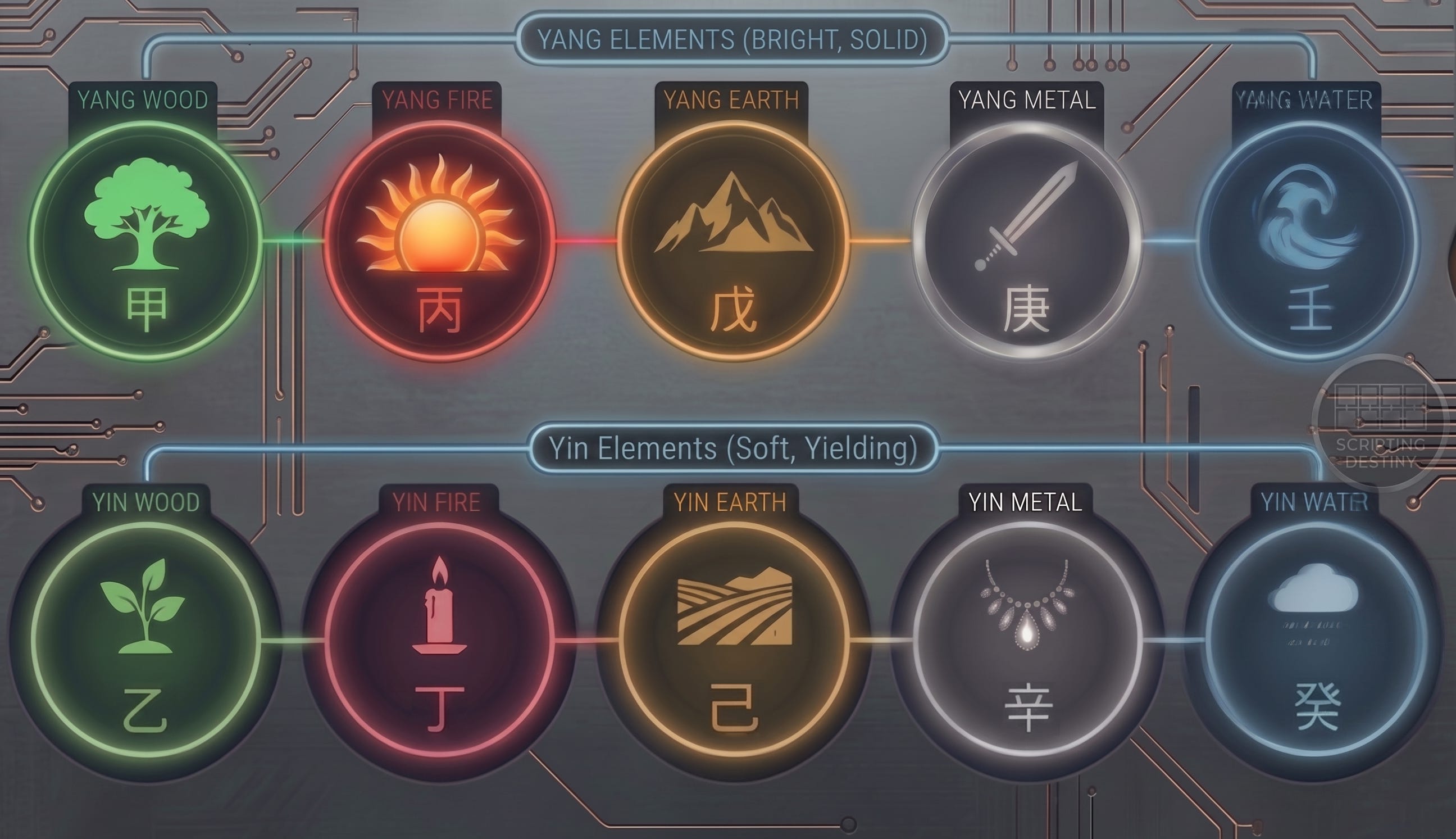
As we learned in the last article, the Heavenly Stems live on the top row of your chart. They represent pure, unmixed Qi, the life forces that constitutes all of existence. The stems on top represent the surface-level events, your public-facing personality, and what the world sees.
The stems represent your Conscious Mind and your overt behavior. It shows the traits you actively project, the decisions you make in the open, and the events that are visible to your peers. The elements here are 'pure' because they lack the messy, hidden complexities of your subconscious desires buried in the row of the Earthly Branches below.
There are exactly 10 Stems. Why 10? Because there are Five Elements (Wood, Fire, Earth, Metal, Water) and two polarities (Yin and Yang). 5 x 2 = 10. It is that simple.
Here is the core alphabet of the Heavenly Stems:
Jia (甲) & Yi (乙): Yang Wood (the towering, stubborn tree) and Yin Wood (the adaptable, climbing vine).
Bing (丙) & Ding (丁): Yang Fire (the radiant, blazing sun) and Yin Fire (the focused, illuminating candle or forge).
Wu (戊) & Ji (己): Yang Earth (the immovable, heavy mountain) and Yin Earth (the nurturing, fertile soil).
Geng (庚) & Xin (辛): Yang Metal (the raw iron ore, the heavy axe) and Yin Metal (the refined, glittering jewelry or scalpel).
Ren (壬) & Gui (癸): Yang Water (the crashing, unstoppable ocean) and Yin Water (the gentle, pervasive mist or rain).
When you look at the top row of your chart - especially your Day Master - you are looking at one of these 10 characters.
The Hidden Foundation: The 12 Earthly Branches
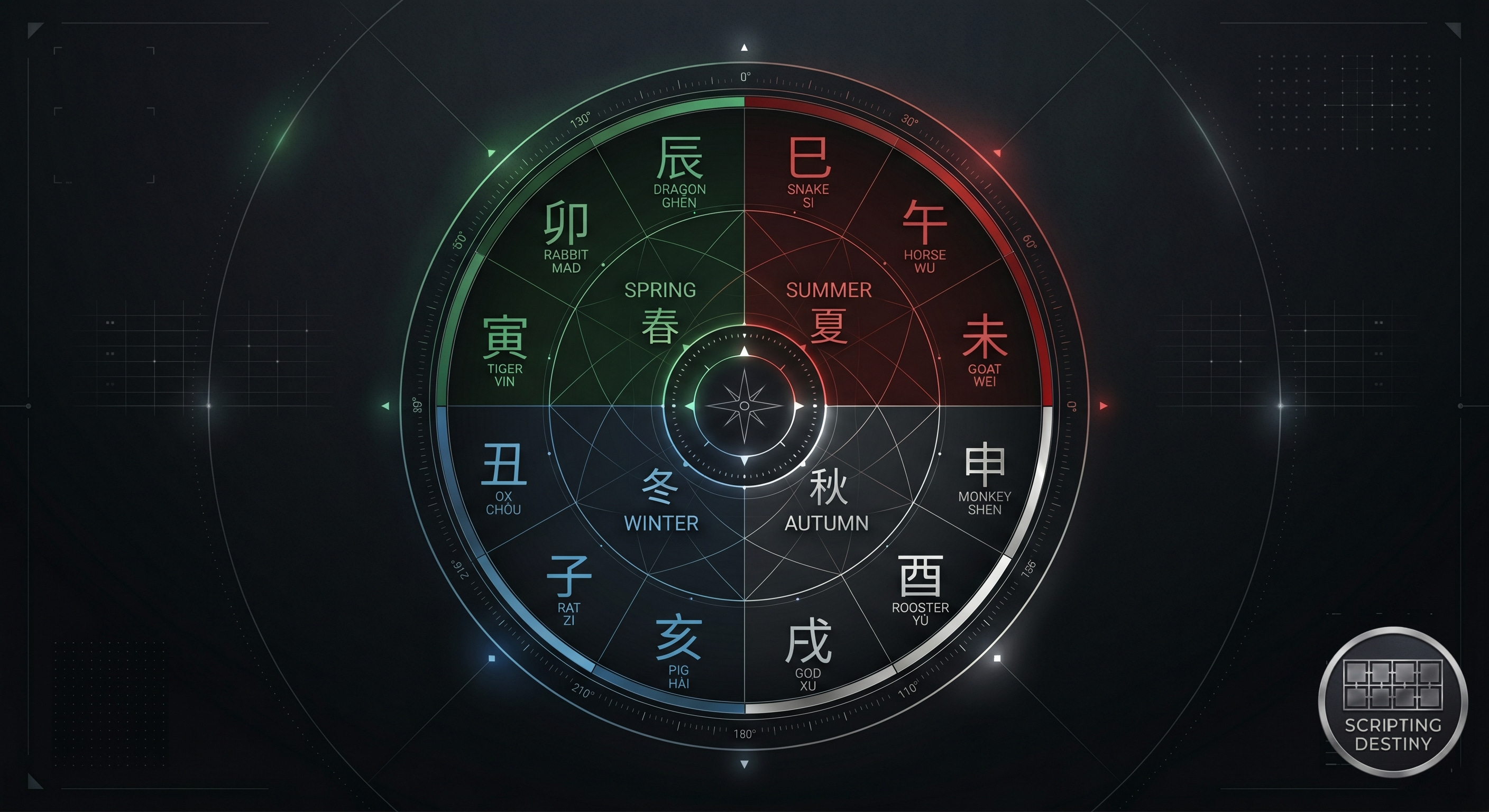
The bottom row of your chart is made up of the Earthly Branches. This is where we need to kill a massive pop-culture misconception.
The 12 Earthly Branches are commonly known as the Chinese Zodiac Animals (Rat, Ox, Tiger, Rabbit, Dragon, Snake, Horse, Goat, Monkey, Rooster, Dog, Pig).
If you were born in the Year of the Dragon, I hate to break it to you: you do not possess the “magical spirit of a mythical lizard.” Despite what superstitious folklore would have you believe, being born in the year of the Dragon doesn’t predestine you for great things. Any “astrologer” who says so probably has a book of creative fiction to sell you.
Ancient Chinese scholars were brilliant astronomers, mathematicians, and agriculturists, not fantasy writers.
The animals are simply ancient mnemonic code words. They were designed as a shorthand tool to help the masses better understand and recall the cycles of time, the changing of the seasons, and complex elemental mixtures.
Each animal represents a specific month, season, and elemental energy:
Spring (Wood Energy): Tiger (寅), Rabbit (卯), Dragon (辰)
Summer (Fire Energy): Snake (巳), Horse (午), Goat (未)
Autumn (Metal Energy): Monkey (申), Rooster (酉), Dog (戌)
Winter (Water Energy): Pig (亥), Rat (子), Ox (丑)
When you see a “Tiger” in your chart, BaZi analysts aren’t looking at feline traits of self-reliance and independence. We are looking at the arrival of early Spring - a massive, explosive surge of Yang Wood energy. When we see a “Rat,” we are looking at the dead of Winter - pure, freezing Water energy.
Putting It Together: Reading a Pillar
Now that you know the alphabet, you can read the code.
A “Pillar” in BaZi is simply one Heavenly Stem sitting on top of one Earthly Branch.
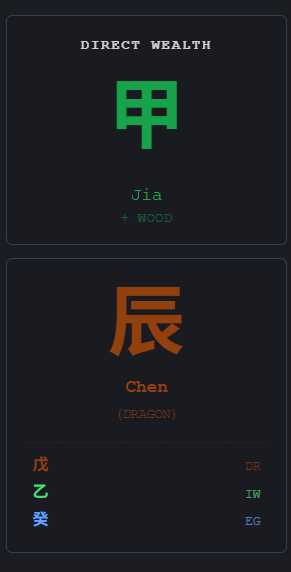
For example, you have likely read annual forecasts stating that 2024 is the Year of the Wood Dragon (Jia Chen 甲辰). Before today, that might have sounded like mystical poetry. Now, you know exactly what the system is calculating.
The Top (Stem): Jia (甲) - Pure Yang Wood.
The Bottom (Branch): Chen (辰) - The Dragon, representing late Spring and Yang Earth.
2024 isn’t a magical lizard in a forest. It is a specific energetic patch: Yang Wood sitting on Yang Earth. If you remember the physics engine from our last article, you know that Wood controls Earth. Its roots violently penetrate the soil to extract nutrients. Therefore, the “Wood Dragon” is a pillar of tension, pressure, structural breakdown, and relentless growth.
You just read your first line of BaZi code.
Now that you know the elements, the polarities, and the alphabet, there is only one piece of the puzzle left before you can start strategizing your own life. In our next article, we will translate this alphabet into the 10 Gods - the psychological profiles and real-world characters that make up your destiny.
Continue with Part IV: BaZi Explainer Series: The Day Master & The 10 Gods
Enjoyed the article? Journey with me, get access to special case studies of how destiny manifests in real life, and learn to script your own destiny.
Disclaimer: Scripting Destiny explores classical BaZi as a structural framework for personal strategy. The content provided here is strictly for informational and educational purposes, and does not constitute professional financial, medical, or legal advice. You are the SysAdmin of your own life; make your decisions accordingly.