
This is Part II of a series of articles to explain the basics of BaZi to beginners and get readers started on understanding their own destiny.
Part I: The BaZi Chart, Your Life’s Source Code
Part III: The Alphabet of Destiny – Stems & Branches
Part IV: BaZi Explainer Series: The Day Master & The 10 Gods
Part V: The Matrix of Time – Luck Pillars & Annual Pillars
In the previous article, we mapped out the components of a BaZi chart. We looked at the palaces, the rows, and the columns to understand where your career, your private life, and your 10-year luck cycles reside.
But a dashboard is just a display. To truly understand how BaZi works - and how to use it to strategize your life - you need to understand the code running underneath it.
Welcome to the underlying physics engine of Chinese Metaphysics: Yin, Yang, and the Five Elements.
The Polarity: Yin and Yang
Before we talk about elements, we have to talk about polarity. In pop culture, Yin and Yang are often misunderstood as “good vs. evil.” In reality, they simply different aspects of nature.
Yang (阳): Active, outward, bright, fast, aggressive, and expanding. It is the sun, the roaring fire, the unyielding mountain.
Yin (阴): Passive, inward, dark, slow, receptive, and contracting. It is the moon, the candlelight, the fertile soil.
Because Yin is associated with darkness and the feminine, popular media often uses it as a lazy shorthand for 'evil' or 'villainy.' This isn't ancient wisdom - it’s just human projection.
Equating Yin with malevolence stems from our primal fear of the dark, mixed with a heavy dose of historical misogyny. In BaZi, there is no morality attached to polarity.
Yin isn't the villain, it's the fertile soil where seeds germinate. It is the restorative rest that makes Yang's explosive action possible.
Every single element in your BaZi chart is either Yin or Yang. The polarity changes the expression of an element. For example, a Yang Wood Day Master can be visualized as a towering, study tree, while a Yin Wood person is often visualized as an elegant flower or flexible vine. A Yang water Day Master may be given the powerful, torrential properties of an ocean while a Yin water Day Master has the attributes of rain or mist.
The Building Blocks: Your Energetic DNA
The characters in a BaZi chart are a language describing your energetic DNA, built from five core components.
The Five Elements (Wu Xing): Everything in BaZi is expressed through Wood, Fire, Earth, Metal, and Water. Each has a Yin or Yang polarity and represents different facets of life:
Wood: Growth, structure, discipline
Wood’s physical nature is defined as “curved and straight” (曲直), representing the structured growth of a tree. It is firm, yet flexible. It governs the constant of Benevolence (仁 - Ren). Each constant governs a person’s baseline psychology, worldview, and moral compass.
When Wood is strong and healthy in a chart, it creates a person who is generous, compassionate, and upright. It grants a structured, principled nature, but if it is too rigid or unbalanced, it manifests as stubbornness and an overly unyielding disposition.
Fire: Passion, expression, visibility
Fire is defined as “blazing upward” (炎上), representing visibility and outward energy. It governs the constant of Propriety (礼 - Li).
Fire’s psychological manifestation is described as quick, highly expressive, and spirited. It grants a person a radiant, majestic presence. However, if Fire is too strong, the passion becomes explosive, resulting in a fiery temper and restlessness.
Earth: Stability, nurturing, trust
Earth is defined as “sowing and reaping” (稼穑), representing the fertile ground that nurtures all life.
Earth governs the constant of Trust (信 - Xin). Its nature is heavy, thick, and highly stable. A balanced, healthy Earth Day Master produces a personality that is deeply reliable, sincere, and broad-minded. An imbalanced Earth chart can produce a person who is either hopelessly stubborn and foolish or deeply toxic, unreasonable, and completely untrustworthy.
Metal: Logic, justice, execution
Metal is defined as “following and altering” (从革), representing the forging of weapons and tools.
Metal governs the constant of Righteousness/Justice (义 - Yi). It has the traits of sharp execution, heroism, and a strict moral compass. It creates a personality that is highly logical, resolute, and decisive. If weak or flawed, it results in a lack of decision-making and inner toxicity.
Water: Wisdom, communication, flow
Water is defined as “moistening and flowing” (润下), representing fluidity, depth, and adaptability.
Water governs the constant of Wisdom (智 - Zhi). It creates a highly intelligent, intuitive, strategic, and deep-thinking individual. When imbalanced, it can indicate someone who is either a restless, manipulative drifter or an erratic, cowardly individual incapable of strategic thinking.
How the Elements Interact
These elements do not just sit passively on your chart. They are dynamic kinetic forces that constantly interact with one another.
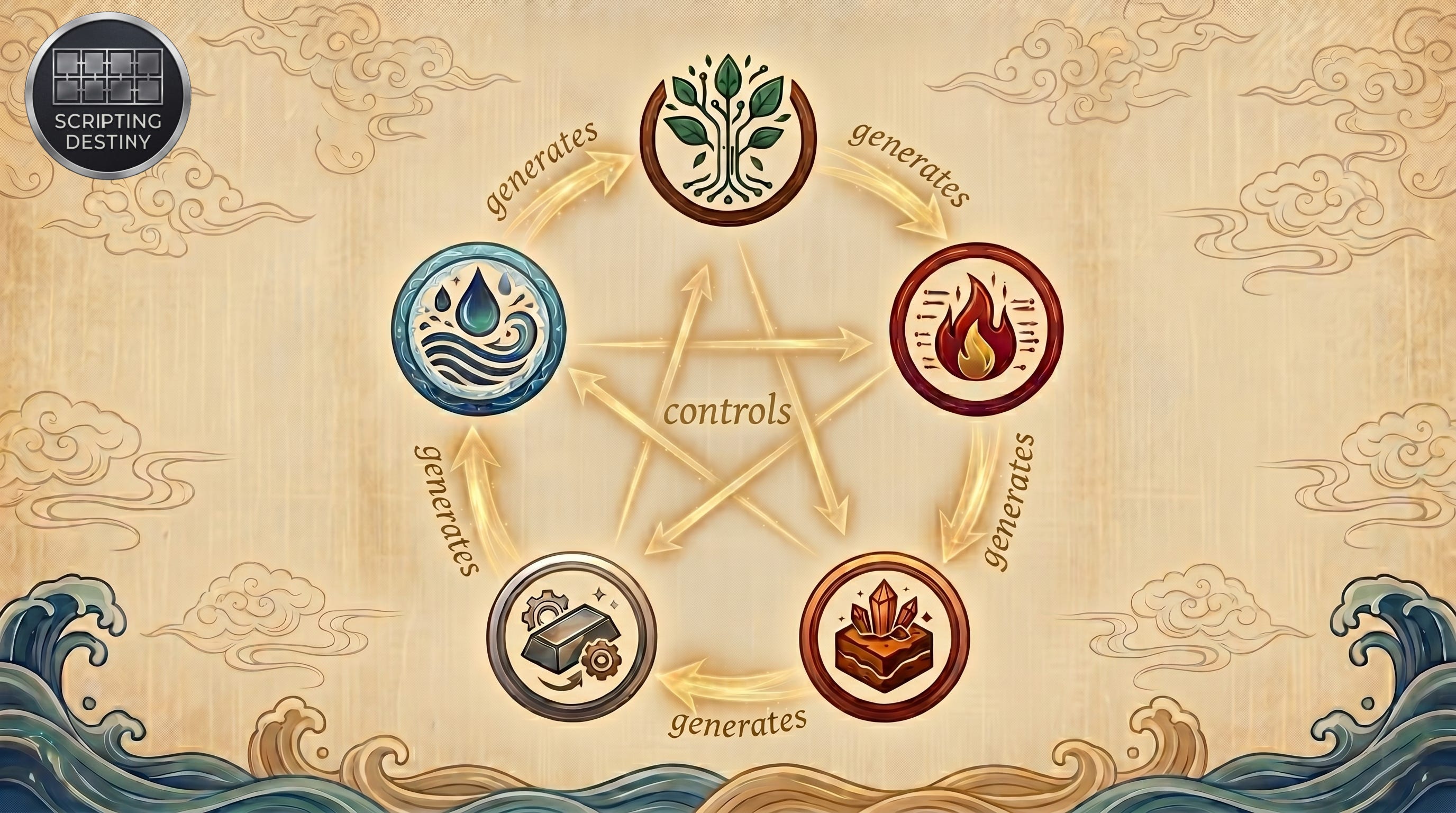
There are two primary cycles that dictate how these elements behave. If you want to understand why your chart is considered strong or weak, why an element is considered beneficial or destructive, or why a specific year brings you massive success or immense frustration, you have to be aware of these two loops:
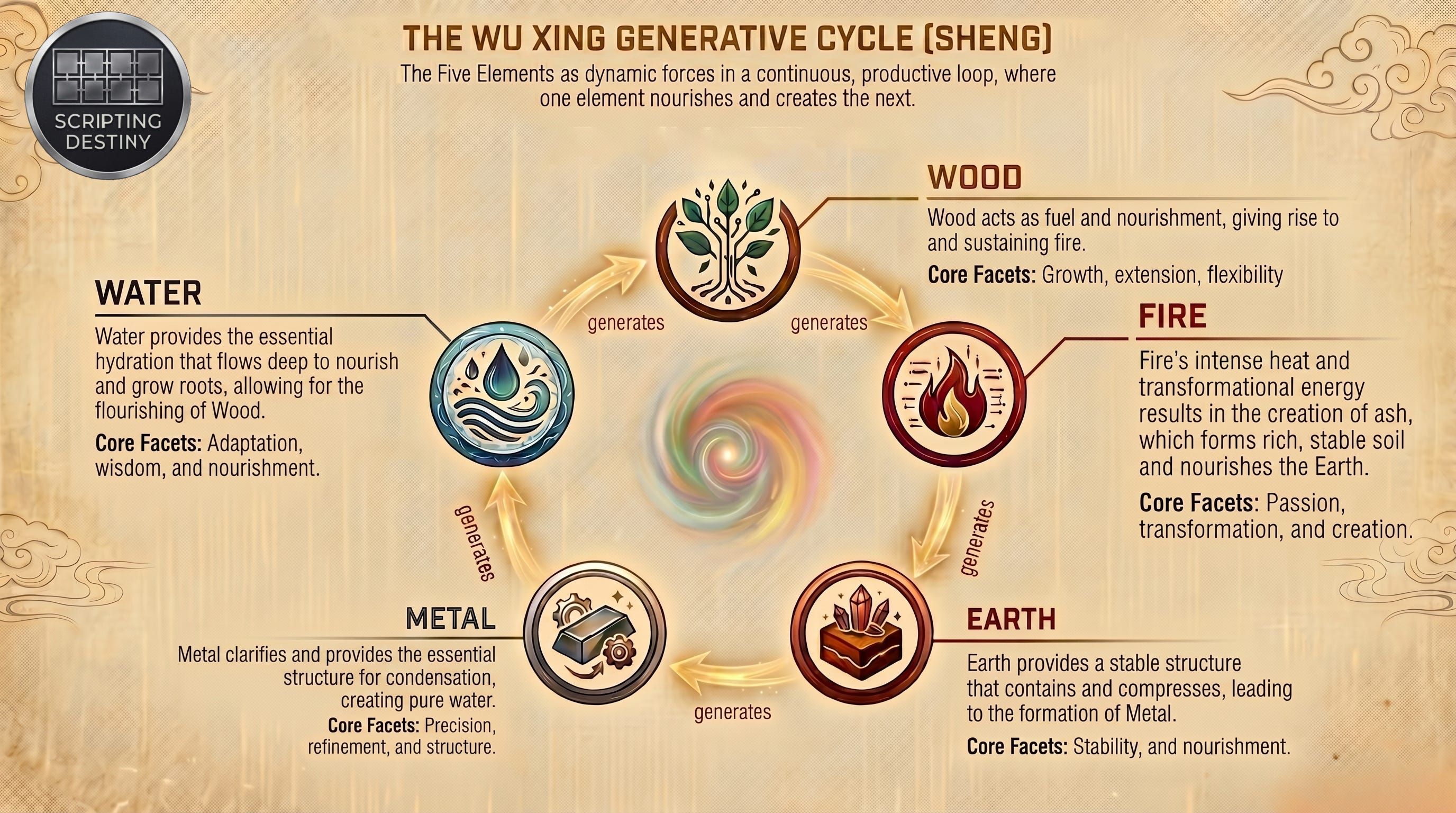
The Generative Cycle (The Production Cycle)
This is the cycle of creation, support, and resource. One element “mothers” or gives birth to the next, strengthening it.
Water waters Wood (Trees grow).
Wood feeds Fire (Logs burn).
Fire produces Earth (Ash returns to soil).
Earth bears Metal (Minerals form in the ground).
Metal holds Water (Condensation forms on metal).
The Destructive Cycle (The Controlling Cycle)
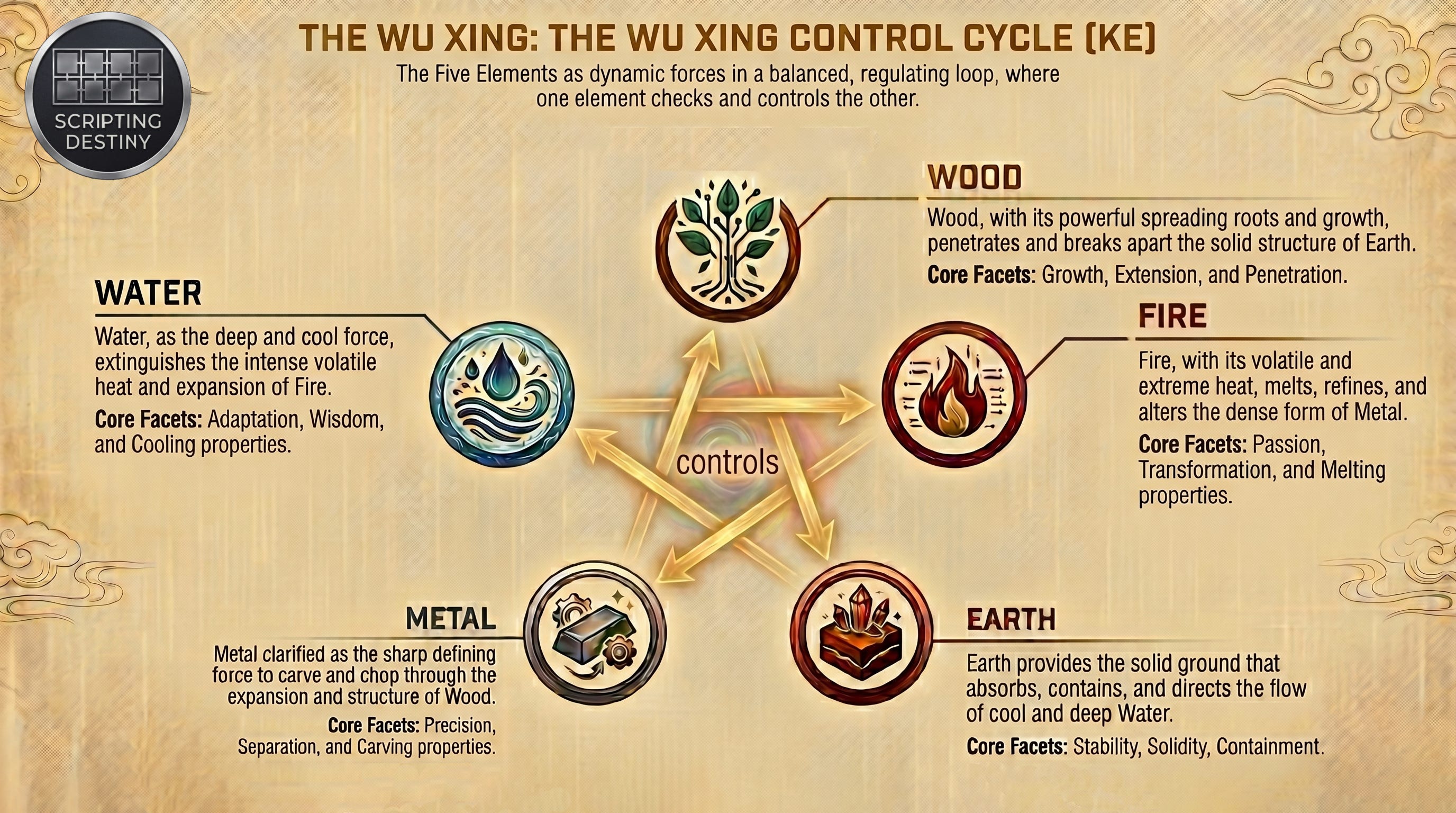
This is the cycle of checks and balances. One element dominates, restricts, or shapes another.
Note that control does not mean bad. In BaZi, if an element is not controlled or disciplined, it runs wild and causes chaos. A chart with rampant fire without water to control or cool it down can manifest as a restless, impulsive individual prone to burnout.
Water puts out Fire.
Fire melts and forges Metal.
Metal chops Wood.
Wood breaks apart Earth (Roots penetrate the soil).
Earth dams and directs Water.
How This Applies To You: The Core Players
So, you have a grid of elements that are constantly producing and controlling each other. How does that translate to you and your actual life?
This brings us to the most important components of BaZi analysis:
The Day Master (日主): Of the eight characters in your Natal Chart, one is the absolute most important: the Heavenly Stem of your Day Pillar. This is the Day Master, and it represents you. Understanding your Day Master is the first step to decoding your chart. Everything else in the chart revolves around this single element.
The 10 “Gods” (十神): The other elements in your chart are interpreted based on their relationship to your Day Master. Using the Generative and Destructive physics we just learned, these relationships form the 10 Gods - not literal deities, but archetypes representing the key players on your “inner team” (such as Wealth, Output, Resource, Authority, and Companions).
All of the 10 Gods in a chart can have a positive or negative manifestation, despite what their names sound like. The energy of the “Hurting Officer” (伤官), for example, can create a rebellious, hyper critical personality that destroys relationships - or a creative mind that moves the needle in their chosen field.
The Useful God (用神): In the complex recipe of your chart, the element representing the Useful God is the single most important one. It’s the key ingredient that brings balance, unlocks potential, and helps remedy the chart’s inherent challenges.
By understanding the Five Elements and the cycles of production and control, you now have the tools to understand the mechanics of a chart. In the next article, we will look at how these elements are disguised as the famous Chinese Zodiac animals, and what secrets they are hiding inside your chart.
Continue with Part III: The Alphabet of Destiny – Stems & Branches
Enjoyed the article? Journey with me, get access to special case studies of how destiny manifests in real life, and learn to script your own destiny.
Disclaimer: Scripting Destiny explores classical BaZi as a structural framework for personal strategy. The content provided here is strictly for informational and educational purposes, and does not constitute professional financial, medical, or legal advice. You are the SysAdmin of your own life; make your decisions accordingly.