
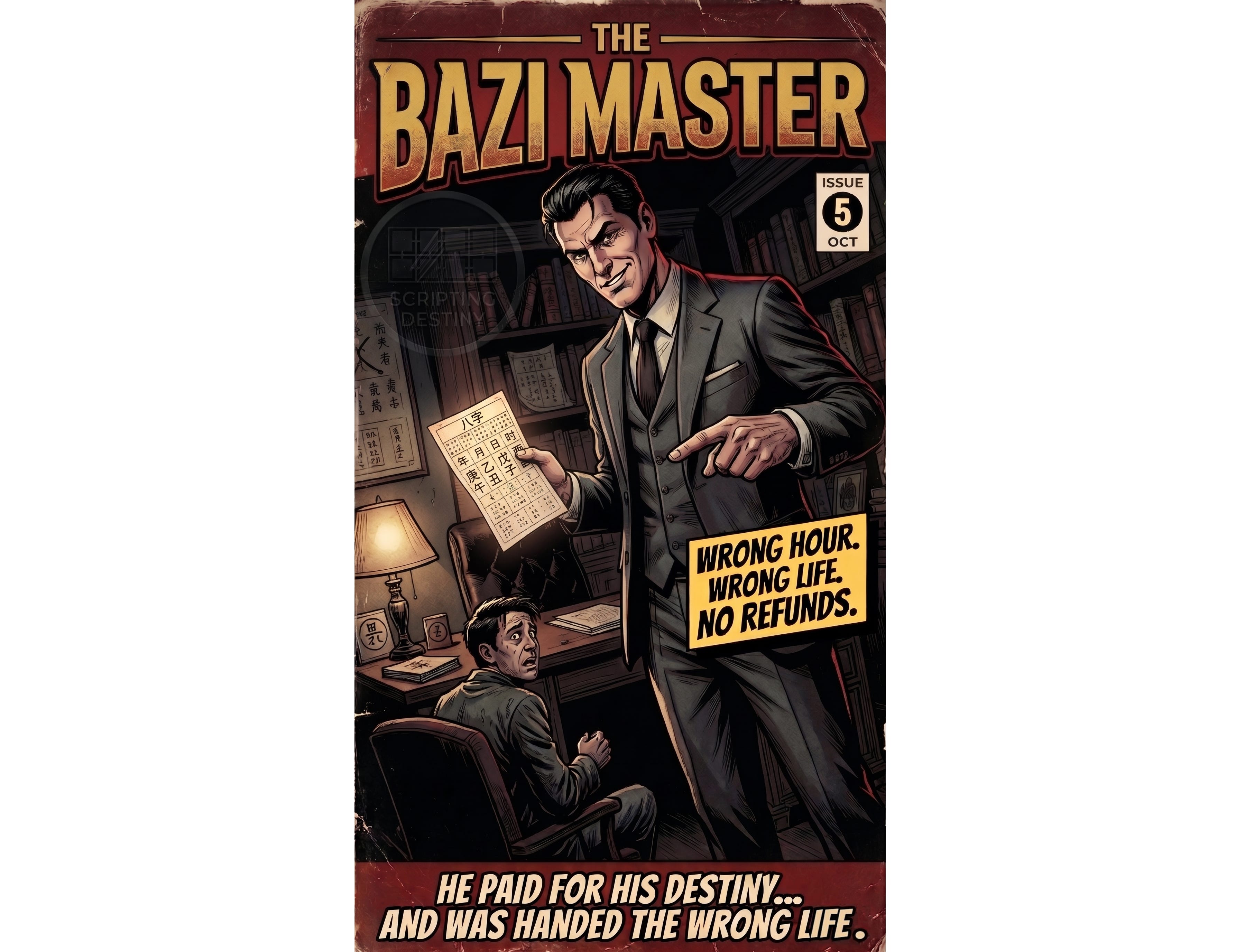
Three years ago, a BaZi master I deeply trusted told me to stop wasting time with my partner.
The bottom dropped out of my stomach when I saw his message. I knew my partner had their difficulties, so I did not expect a glowing pronouncement of their chart being “elite” or “high quality.” But neither was I expecting a chart so bad, the master would pronounce a death sentence for our relationship.
What shocked me the most was the sheer disconnect from reality. I was in a happy relationship with someone who loved me exactly for who I was, warts and all. They were kind, thoughtful, and deeply talented. They certainly didn’t fit the mold of the lazy, irredeemable layabout the reading painted them to be.
He claimed my partner’s chart was so exceptionally weak that he refused to even conduct a proper compatibility analysis. When I pushed back and asked questions to understand the actual dynamics at play rather than blindly accepting his fatalism, he grew angry. He threw a fit over a question about a single character on their chart, abruptly voided the remainder of my consultation, and walked away with my nearly $800 non-refundable fee.
To outline the rest of that disastrous consultation would take an entire article, but the TL;DR is this: he deemed my partner a lost cause with zero capacity for personal growth, incapable of adding value to my life. When I asked about their prospects in the career they aspired to, the master condescendingly asked if my partner even knew how to use the basic tools of the trade.
My partner had earned a professional qualification in that exact field as a teenager.
The most dangerous part of this encounter wasn’t just the insult. It was the intellectual laziness. This master was so caught up in his preconceived notion of who my partner was that he was entirely blind to their actual talent and the evidence contradicting his assessment.
He had calculated the chart correctly. But because the chart was highly unconventional and difficult, he chose to attack and insult rather than apply the nuance required to actually understand the human being he was condemning.
Here is the truth: My partner is not perfect, and their chart is not an easy one. We are currently on a break, navigating our joint issues.
Some of those issues were actually exacerbated by the flawed reading itself. When my partner stumbled, living out the flaws shown in their chart, my own insecurities whispered that maybe the master was correct about them, and no matter how hard we tried, they could never be a good partner.
There are signs in our charts that support a breakup, but none of those reasons have anything to do with my partner failing to bring value to my life. The happiness they brought me and the emotional growth I experienced with them for the better part of four years put paid to that lie. Nor does their actual chart dictate an inability to build a functional, meaningful career.
When I finally learned to read BaZi myself, I looked at the exact same chart and everything clicked.
The chart wasn’t easy. It indicated major internal friction and structural challenges. But where the master saw a permanent death sentence, classical mechanics revealed something else entirely: an artist who was simply not wired for success in a conventional corporate environment.
But, it supported the path my partner had naturally gravitated to and was working towards.
The master didn’t see a struggling human being with a fighting chance. Because of his rigid, fatalistic idea of what a “good” life should look like, he looked at a highly complex chart and saw only a professional NEET leeching off a caretaker.
Fast forward three years: My partner went back to university, is a straight-A student, and recently organized a major event that earned unprecedented testimonials from industry professionals. They have been accepted into a Master’s program. They still battle their demons every day, but they are trying, growing, and achieving.
Does that sound like a lost cause? Or does it sound like a practitioner who fundamentally misread a human being?
After I learned BaZi for myself, I realized why Chinese Metaphysics has taken on such an unsavory reputation for many. From the lack of regulation, to the templates and shortcuts modern schools advocate, to a total disregard for professionalism and ethics - there are so many ways a BaZi “master” can get things wrong and bank on the ignorance of their clients to get away with it.
Before you let a stranger dictate your fate, here is why your BaZi master might be misreading your source code:
1. Schools That Oversimplify BaZi
In the J-drama Straight to Hell, the protagonist is warned as a beginner that it takes at least ten years of studying the classical texts before one can properly tell fortunes.
Why? Because while the Zi Ping school - the most ubiquitous system of BaZi - offers a standardized way to read charts, those standard methods simply cannot cover all cases. There are myriad exceptions to the rules, and subtle thermodynamic forces to consider far beyond basic elemental balancing. In fact, the explanatory notes in the foundational Zi Ping Zhen Quan (子平真诠) state that using standard seasonal methods to identify a chart’s “Useful God” only works for about 70 to 80 percent of charts.
Before the age of digitization, search tools and AI, a master had to spend years memorizing entire volumes so that they could correctly identify a chart’s structure in a reasonable amount of time, as well as any possible exceptions that applied to it.
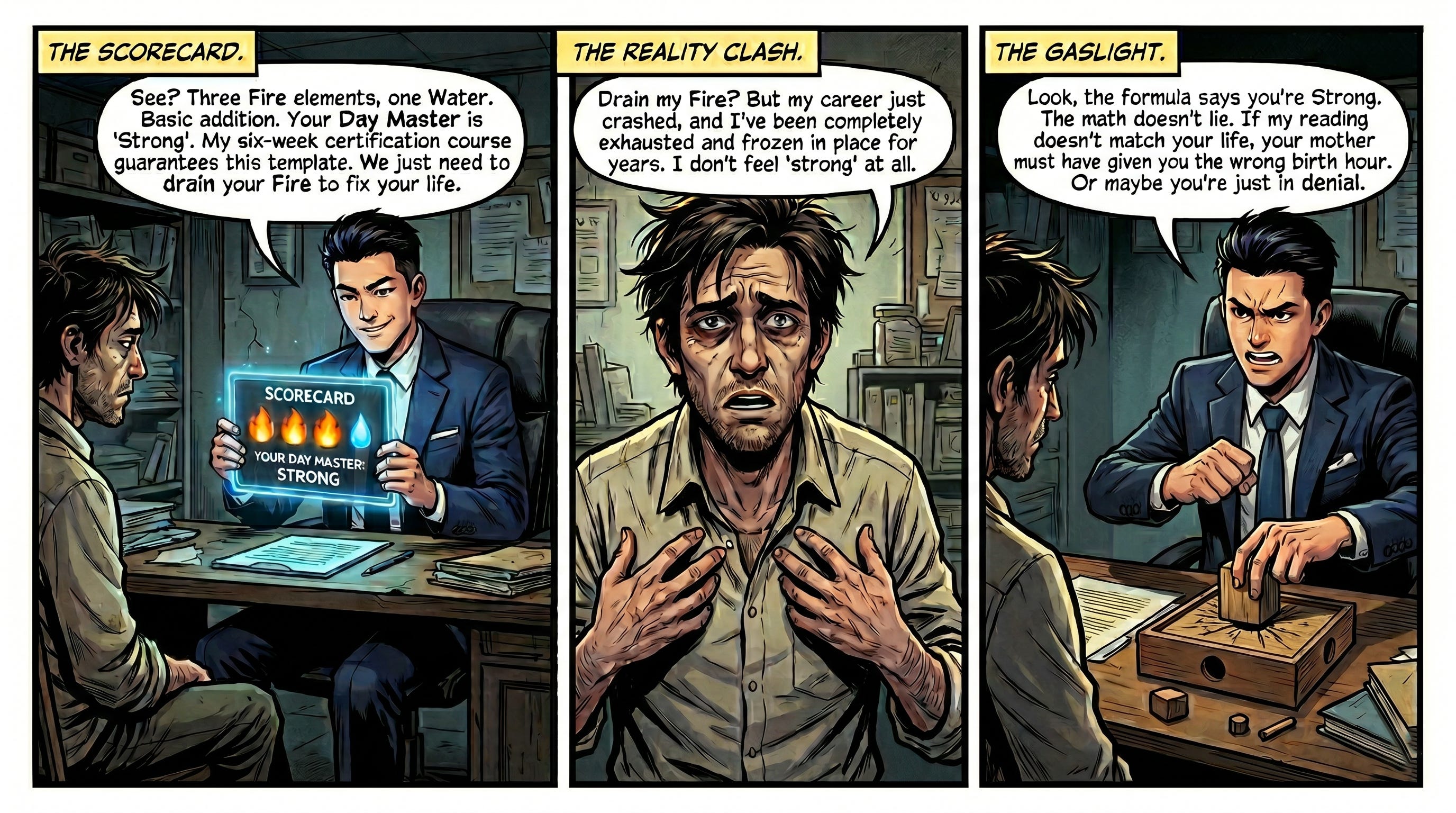
Yet today, many modern schools peddle courses that supposedly elevate you to practitioner status in a matter of months, if not weeks. These schools teach simplified, templated methods. They will look at a Fire Day Master, count three Fire elements, an Earth season, and a single Water element, and immediately declare the Day Master “Strong.” They then blindly apply the textbook cure: drain the strong Day Master to achieve balance.
This completely ignores the actual physics of the chart. Is that Fire burning in the dead of winter, desperately trying to keep the ecosystem from freezing? Is the Earth wet and muddy, or dry and cracked? You cannot evaluate a chart’s structure just by tallying up elements like a scorecard.
Even worse, when this templated approach inevitably fails to align with the client’s lived reality, the master’s ego takes over. Instead of investigating further, they will insist the client must have the wrong birth hour, or accuse the client of being in denial about their life.
Rather than listening and putting in the effort to verify the chart, they attempt to gaslight the client’s square peg into the round hole of their lazy math.
2. The Trap of Fatalism
Having the correct chart is only half the battle, interpreting it requires nuance and empathy. Unfortunately, the commercial industry is rife with practitioners who see a difficult chart and immediately make fatalistic assumptions about the client.
Classical BaZi acknowledges that some charts are smooth and some are turbulent. A chart with heavy elemental clashes or weak favorable elements simply means the individual will face more obstacles to success in life. They might have to take an unconventional route.
But lazy practitioners equate a difficult or unconventional life path with an inherently flawed character. They look at a turbulent chart and declare the person a lost cause, incapable of growth.
This is a massive interpretive leap. A chart might indicate that someone will face severe career hurdles or emotional battles, but it cannot dictate that they are incapable of loving, learning, or actively working to overcome those battles.
When a master hands you a reading of apocalypse for your life or relationship, they are not reading your destiny - they are projecting their own inability to navigate the unconventional and the complex.
3. Projecting Moral and Societal Values
BaZi was codified during dynastic, feudal China. It was a society that prioritized clan survival, male heirs, and absolute obedience to the hierarchy.
Many modern masters have entirely failed to update this sociological framework. Instead of reading the objective mechanics of the elements, they project their own conventional, often highly conservative moral values onto the client.
They will label a late bloomer’s chart a “failure” or “wasted potential” simply because it doesn’t indicate a traditional corporate ascent during their twenties. They will look at a challenging luck phase and decide your real-world struggles are a personal choice, claiming your hardships are entirely your fault for refusing to grow. They will tell a fiercely independent woman that her chart is “cursed” to harm her husband, simply because her elements naturally rebel against the “Authority” star.
Your chart is not a moral compass. It is simply a guide to your psychology and a map of your potential. The elements do not care about the modern white-picket-fence ideal. They simply indicate the mechanics of how you process the world - and how you can build your best life, even if it is a highly unconventional one.
Yet, the commercial industry routinely crosses the line from energetic analysis into outright moral condemnation.
When a practitioner publicizes the idea that a difficult or ‘unevolved’ birth chart equates to being “human garbage”, they aren’t practicing metaphysics - they are practicing cosmic eugenics. They imply that your struggles aren’t lessons to be managed, but a definitive proof of your worthlessness. In which case, why bother paying a BaZi master just to be condemned?
Social norms dictate the manifestation of a chart. If a master is not actively interpreting ancient mechanics through a 21st-century socio-economic lens and offering relevant advice, their reading is useless.
Take the Hurting Officer (伤官) star. In classical texts, an unchecked Hurting Officer is viewed as disastrous - especially for women. It represents a rebellious, often intelligent energy that actively attacks the “Direct Officer” (which represents rules, tradition, and the husband). In ancient China, a person with this chart was a traitor, a rebel, or a cursed spouse.
But what is an unchecked Hurting Officer today? It is commonly found in the charts of tech disruptors. It is the brilliant entrepreneur with ADHD symptoms who shatter outdated industry models to build an empire. It is the stand-up comic who gains celebrity through subversive social critique. And in the modern world, either gender can weaponize this energy for massive success at any age.
A chart that would have gotten you executed in the Ming Dynasty might be exactly what makes you a multi-millionaire today.
4. The Echo Chamber of the Career Fortune-Teller
There is a practical reality that clients often overlook when seeking high-level advice: Many masters have spent their entire adult lives in the metaphysical echo chamber.
If a practitioner has spent twenty years sitting behind a consultation desk, their understanding of the modern world and workplace is entirely theoretical - stitched together from ancient texts and the secondhand complaints of other clients.
If they have never navigated the cutthroat politics of climbing a modern corporate ladder, how can they accurately interpret a senior executive career bottleneck? If they have never built a scalable startup or managed complex operational overhead, how can they advise a founder on pivoting and bootstrapping models just by looking at a “Wealth” star? There is a massive difference between running a cash-upfront consulting practice and surviving the trenches of a competitive modern industry.
Worse yet, if a master has lived a highly conventional, sheltered life, they are fundamentally incapable of advising someone whose chart demands a radically unconventional path. They simply lack the lived vocabulary for it.
When you ask such a practitioner for life strategy, they usually default to safe, generic tropes: “Your chart needs Water, so you should work in shipping.” or “You will have issues with money. Find a source of passive income”. This isn’t strategy, it’s a parlor trick.
Your BaZi chart is a map of potential, but a map is only as good as the guide reading it. You cannot expect a guide who has never left the theoretical village to successfully guide you through the complex, unique terrain of a modern, divergent life.
5. The Fatal Flaw: They Don’t Know You
Ultimately, the greatest reason a master misreads your chart is that they do not take the time to know you.
A BaZi chart does not exist in a vacuum. It is a blueprint, but it is built upon by your upbringing, your free will, your trauma, and your environment. Two people can have the exact same chart, and one might channel their chart’s volatile obsessiveness into building a revolutionary business, while the other might succumb to it and end up in prison.
If you meet a master that lacks empathy and a desire to understand people who think differently from them, no matter how good their technical reading, they are unlikely to give good advice for your unique life.
A good reading should be a two-way dialogue. But too many masters view themselves as untouchable authorities dispensing unquestionable pronouncements from on high, delivering skewed, fear-based readings that offer no actionable strategy to actually improve your life.
The Solution: Become the Architect of Your Own Destiny
You do not have to leave your destiny in the hands of a practitioner who does not care to get to know you, refuses to check their math, and projects their own limitations onto your potential.
This isn’t to say human practitioners are inherently obsolete. A genuinely skilled master - one who can observe your mannerisms and personality as part of meticulously verifying your data, interprets the classics through a modern lens, brings a diverse life experience and treats your reading as a collaborative strategy session - is a wonderful resource. But finding a mentor of that caliber is rare, often prohibitively expensive, and still requires handing your vulnerability over to a stranger.
This is where AI changes the game entirely.
We no longer have to rely on a human middleman to access the mechanics of our own lives. By learning just the foundational concepts - your Day Master, your elements, the 10 Gods, and the environmental shifts of your Luck Pillars - you can leverage AI to do the heavy mathematical lifting and objective cross-referencing.
Some might argue that AI lacks human intuition. I argue that AI lacks human bias.
An AI does not judge your relationship style or your current lack of success. It does not have a fragile ego to protect. It does not project patriarchal baggage onto your relationship or career goals. It simply calculates the dynamics of your chart, and provides an unfiltered, objective mirror of your cognitive baseline when you ask it to.
More powerfully, it has the ability to draw from modern psychological and therapeutic texts, combining them with the vast repository of human experience shared online. When done right, and the conversation shaped properly, the result is a holistic, modern interpretation completely stripped of the personal biases and fragile egos that so often color human analysis.
True psychological “Medicine” isn’t found in a master’s validation - it’s found in understanding yourself. When you use AI to map your chart, you bring the empathy, the intuition, and the lived experience relevant to yourself. The AI simply brings the math and suggests the strategy, helping you build an actionable plan. Provided you know enough of the basics to steer it accurately and check for hallucinations, of course.
Stop paying arrogant strangers to condemn you to a bad destiny. Learn the code, partner with the machine, and become the architect of your own life.
Enjoyed the article? Journey with me, get access to special case studies of how destiny manifests in real life, and learn to script your own destiny.
Disclaimer: Scripting Destiny explores classical BaZi as a structural framework for personal strategy. The content provided here is strictly for informational and educational purposes, and does not constitute professional financial, medical, or legal advice. You are the SysAdmin of your own life; make your decisions accordingly.