
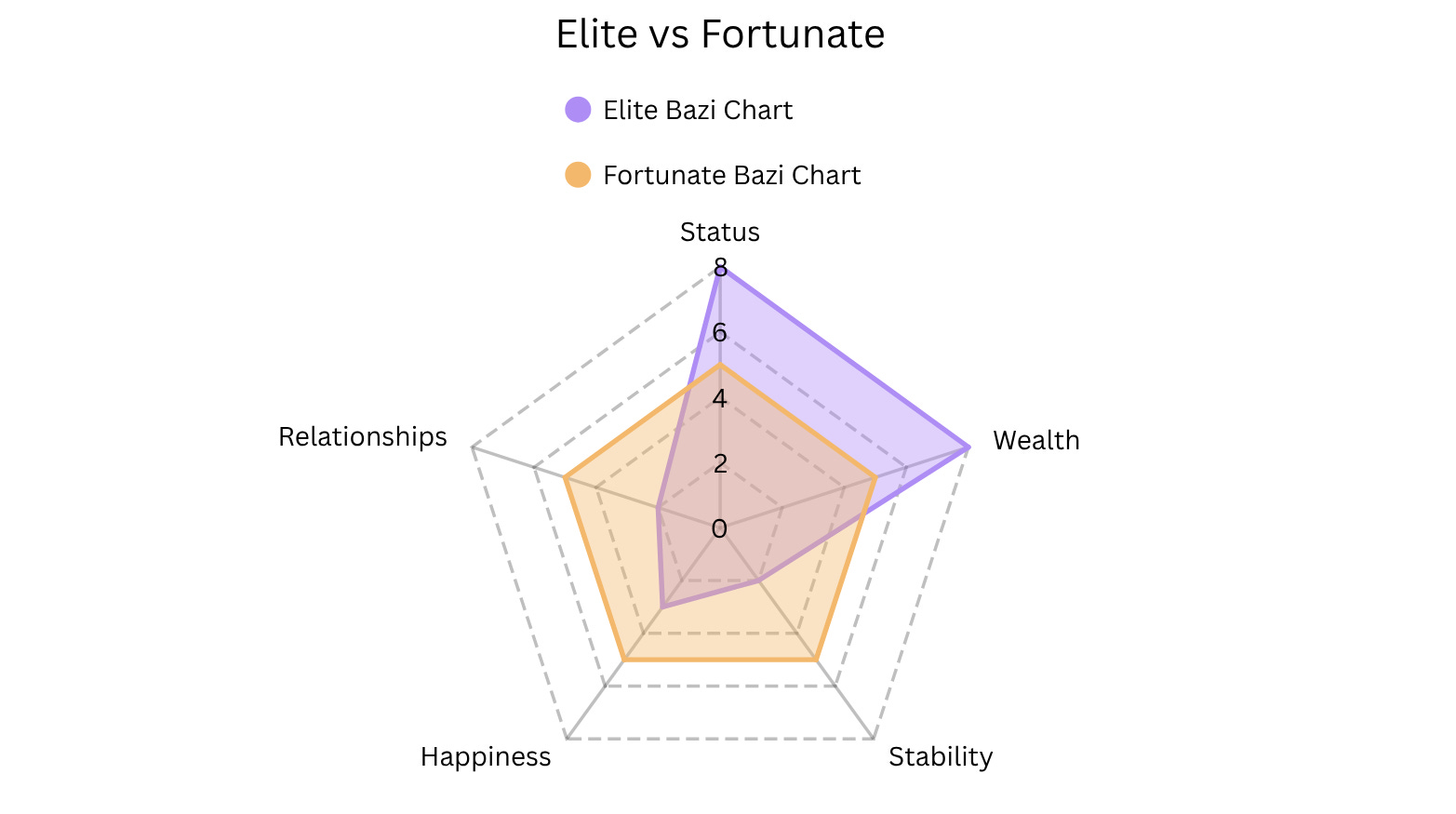
When I was twenty-four, beginning a promising career in media, a Bazi master looked at my chart and told me I would never be wealthy.
Could I start a successful business? Yes. Would I have a comfortable life? Also yes. But if I wanted the kind of “F**k You money” that lets billionaires get away with (sometimes literal) murder? Absolutely not. My chart was simply not built that way.
This was unacceptable to me. I had grown up surrounded by family eager to take every opportunity to tell me how deficient I was. The message that the only way to receive their approval and respect was through enormous, undeniable material success was deeply ingrained in my psyche.
I hit the master with a barrage of questions, desperately asking if there was a way to become the next Mark Zuckerberg. Looking back, I now appreciate his patience with me trying to argue with the cosmos through him.
Finally, with an aggravated sigh, he told me to appreciate how fortunate my chart was. Extreme wealth, he explained, requires extreme imbalance. For someone to build that kind of empire, something else in their life had to give.
The best kind of life from the view of Bazi is a balanced one where a person lives comfortably, has a happy family, and enjoys good health - a combination almost never found in the charts of the ultra-rich.
It wasn’t until I studied Bazi for myself that I realized what that master was actually trying to communicate.
When we look at a Bazi chart, it is incredibly tempting to search for cosmic permission to be successful. We scan our elemental makeup hoping to find that we can have it all, wealth, power, love, and health.
However, the foundational texts of classical Bazi - while seemingly transactional in their evaluation of Fu (富 - Wealth) and Gui (贵 - Nobility/Authority) - are actually describing extreme psychological profiles.
In our modern pursuit of a flawless destiny, we often conflate the intense, trauma-driven psychological structure required for massive societal success with a completely different concept: Fuqi (福气 - Blessings and Peace).
Understanding the mechanical differences between a mind built for empire, a nervous system plagued by internal friction, and a psyche blessed with in-built emotional regulation fundamentally changes how we view our own potential.
The Illusion of Perfection: Fu, Gui, and the Obsessive Drive
To achieve extreme Fu or Gui according to classical mechanics, a chart cannot be perfectly balanced or peaceful. Psychologically, this means the individual is not well-rounded. They possess immense cognitive clarity (Qing 清) and a highly concentrated, often obsessive, distribution of mental and emotional energy.
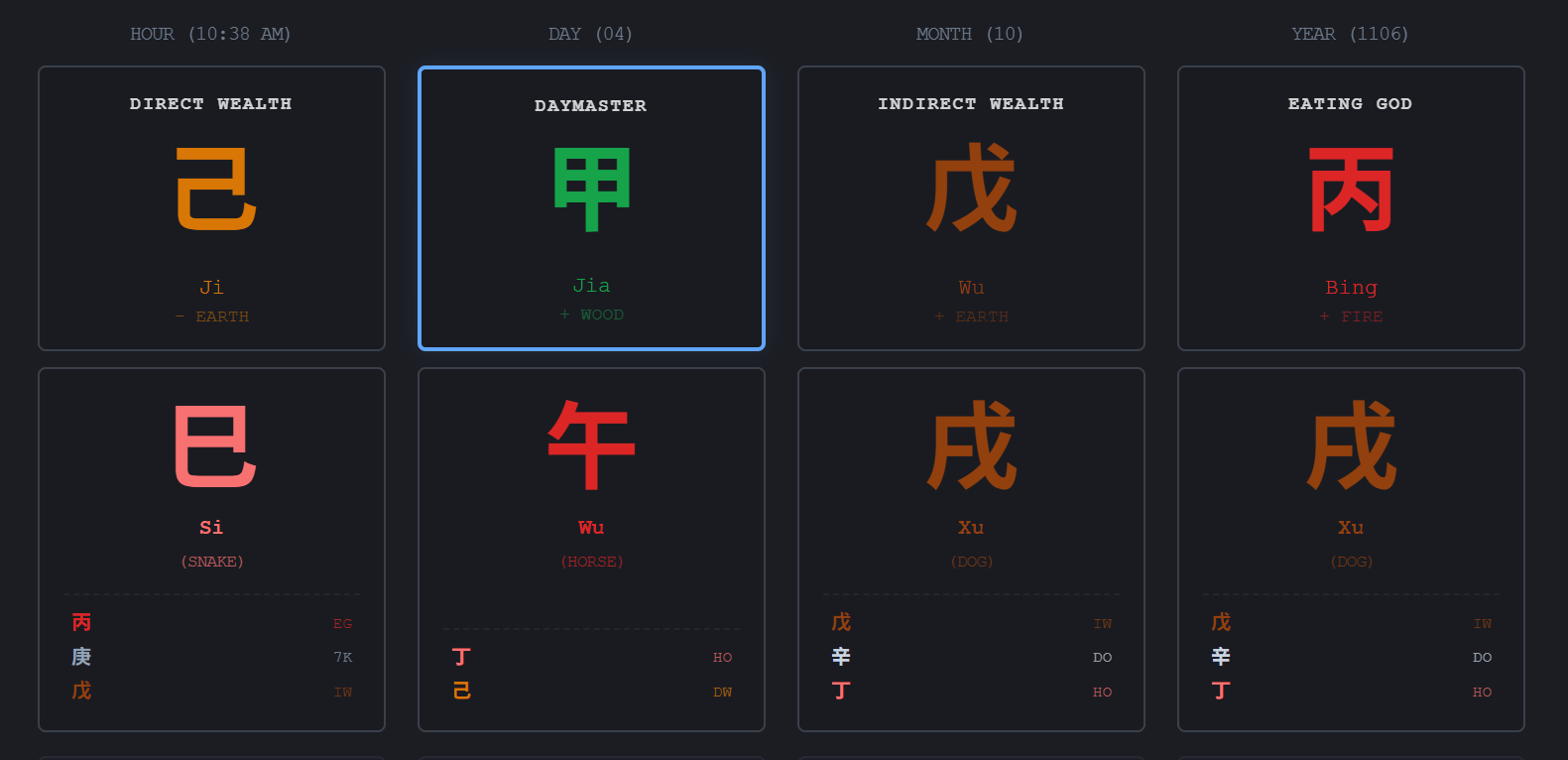
Consider the Bazi of Southern Song dynasty Grand Preceptor Shi Hao, preserved in the foundational text Yuan Hai Zi Ping as a prime archetype of a top-tier Fugui destiny.
Shi Hao rose from childhood poverty to attain the absolute pinnacle of political eminence. As Grand Preceptor, he was one of the top three officials in the empire, and he amassed immense wealth. However, because his Jia Wood Daymaster is entirely engulfed by a scorched desert of Fire (intellectual output) and Earth (wealth) with zero Water or Wood for foundational support, his Fugui status came at a steep personal cost.
He was a 'weak wood' tasked with carrying a mountain. He experienced relentless physical and psychological exhaustion. Historical records show he frequently clashed with fellow ministers and military officials, over-exerting his intellect to maintain his footing in an imperial court that was constantly at war for its survival.
Curing an Elite Chart’s “Sickness”
The most powerful charts rely on the concept of ‘Sickness and Medicine’ (病药). In psychological terms, the ‘Sickness’ is a deep, driving core wound or hyper-fixation; the ‘Medicine’ is the potent coping mechanism or external support that channels that wound into achievement.
The best Fugui charts in BaZi tend to feature a ‘Sickness’: “Only when there is a sickness can one be noble. Without injury, it is not extraordinary. If the sickness within the structure is cured, wealth and status will naturally follow.” (有病方为贵,无伤不是奇。格中如去病,财禄两相随)
In Shi Hao’s case, his ‘Sickness’ was the structural imbalance of a rootless Daymaster being crushed by the very wealth and power he wielded. His ‘Medicine’ did not exist within the vacuum of his birth chart; rather, it was delivered through decades of favorable ‘Luck Pillars’ - the arrival of Water and Wood elements in mid-life that finally provided the ‘roots’ and cooling moisture necessary to shoulder his heavy destiny.
Shi Hao’s story is not unique. His rise from rags to riches and his high-stakes political maneuvering form the archetypal blueprint of the extreme achiever. The ‘Sickness and Cure’ dynamic explains both the raison d’être and the profound fragility of the elite.
Many high achievers are ultimately driven by trauma or a deep desire to fix something about their lives. Without the arrival of the ‘Medicine’ to help them regulate and channel that drive healthily into their work, the hyper-fixated individual simply burns out or collapses under the weight of their own ambition.
Because Fugui individuals are intensely focused on driving toward wealth or power, their psyches inherently lack balance. All of their psychological bandwidth is funneled into career or accumulation, leaving other areas - like emotional intimacy, physical health, or family - barren or vulnerable to collapse.
Think about how the archetypal empire-builder operates during their ascent. They are often described as possessing a singular, almost obsessive psychological focus. Modern visionaries and industry titans are frequently celebrated for working unimaginably grueling hours, risking bankruptcy pouring the entirety of their early wealth into highly uncertain ventures, or even sleeping on factory floors to ensure a product’s survival. Their cognitive bandwidth is entirely consumed by their vision.
Yet, this extreme concentration of energy demands a heavy toll elsewhere. For all their professional brilliance, individuals with these extreme chart structures often experience profound instability in their personal lives.
Because their psychological resources are funneled so intensely into conquest and innovation, the areas of life requiring softness, compromise, and emotional regulation - like marriage, family, and interpersonal relationships - are often neglected or fraught with conflict. The relentless drive that makes them unparalleled CEOs can easily translate into rigid, demanding, or volatile behavior in their private spheres.
Furthermore, one of the greatest vulnerabilities of an extreme, hyper-focused chart is its fragility in the face of disruption. When these individuals encounter a “Luck Pillar” (a 10-year astrological cycle) that violently clashes with their chart’s dominant flow, the consequences can be catastrophic.
History and public records are full of business magnates who experience sudden corporate ousters, highly publicized legal battles, or devastating financial bankruptcies exactly when their favorable cycles break.
This astrological mechanic explains why an empire-builder’s life is inherently volatile. The highs are historic, but the lows can be personally and financially devastating to a degree the average person will never experience.
Classical Bazi masters revered the clear, extreme Fugui chart structures because ancient society prioritized societal contribution, historical legacy, and clan survival over individual happiness. But as the biographies of the rich and powerful routinely demonstrate, the lived reality of an extreme Fu (Wealth) or Gui (Authority) chart is rarely peaceful. It is a life of high stakes, intense rivalries, and profound personal sacrifices.
The Quiet Power of Fuqi: Balance in all Areas
If extreme charts are fueled by obsessive wounds and broken charts are exhausting, where does happiness lie? It lies in Fuqi (福气 - Fortunate) - the capacity for contentment, fulfilment and secure attachment, all backed by an in-built capacity to regulate one’s nervous system.
Interestingly, the charts that possess the most Fuqi are rarely the ones that achieve extreme wealth or power. A chart with high Fuqi tends to be fundamentally balanced.
Because a Fuqi chart holder’s psychological elements flow gracefully, they avoid the massive dopamine highs and devastating cortisol crashes of the extreme Fugui charts. When a difficult life event arrives, the Fuqi individual possesses enough internal ‘padding’ and structural stability to absorb the hit without their entire world collapsing.
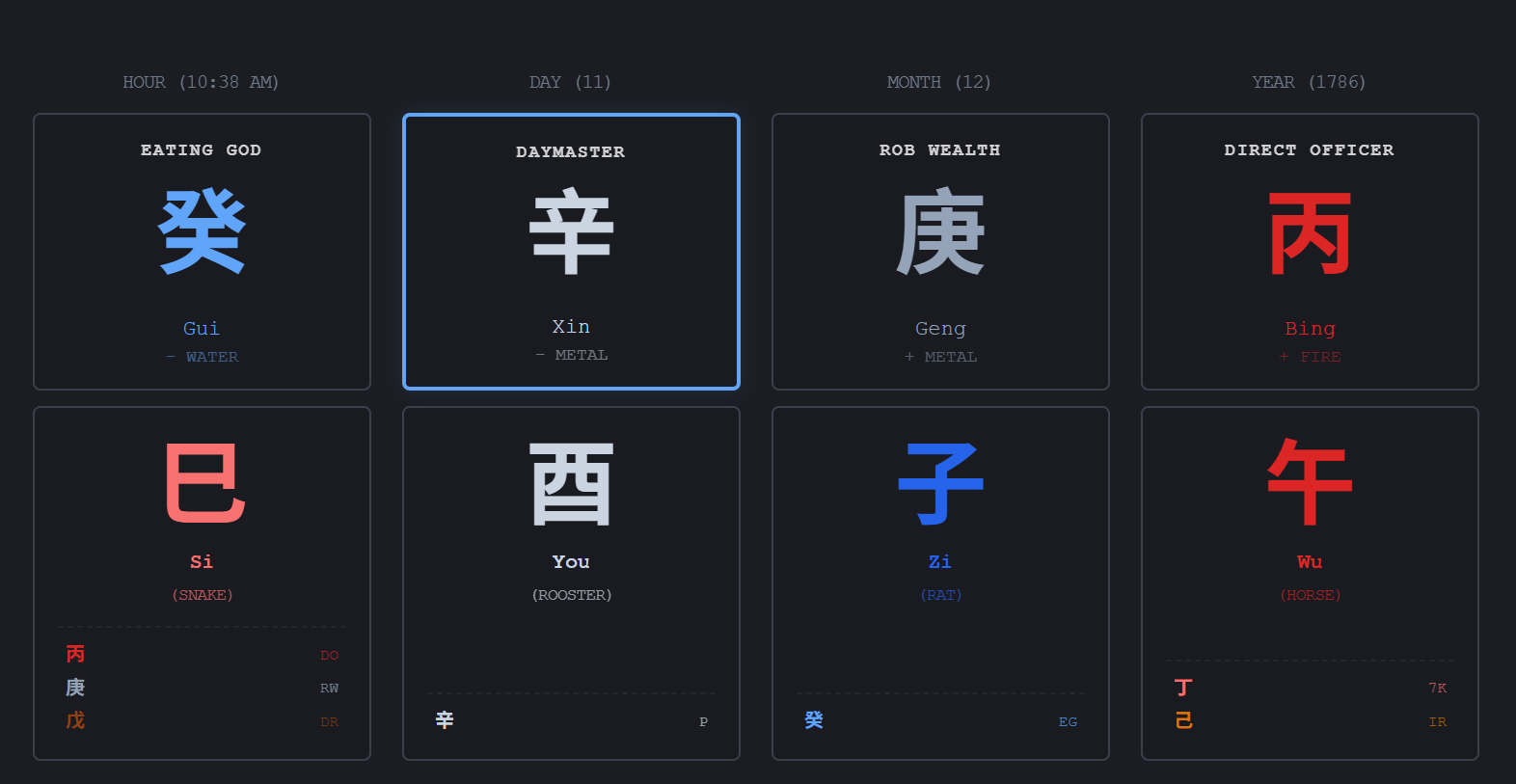
The chart pictured above is an example of a top-tier “Fuqi” chart for fortune and longevity from the foundational text San Ming Tong Hui. Evaluated as the absolute pinnacle of an ancient female’s destiny, it represents a woman who achieved the ultimate societal ideal of her time: personal fortune, a highly successful marriage, and a flourishing lineage.
Because her Xin Metal Daymaster sits perfectly supported on its own prosperous root (You), she possessed the deep foundational vitality and strength necessary to actually carry and enjoy her immense blessings. The chart achieves a rare, flawless harmony: her Husband Star (Bing Fire) and Child Star/Longevity Star (Gui Water) are both supported or deeply rooted. This means they are equally matched in power. Her marriage and her role as a mother complemented rather than consumed one another.
This “Golden White and Water Clear” (金白水清) elemental structure signifies a life of effortless elegance. Her husband provided social status, her children achieved great success, and she enjoyed lasting health and material comfort without the bitter sacrifices usually demanded by such high status.
While the specific metrics of success have evolved since the Ming Dynasty, the underlying psychological reality of this chart structure remains unchanged. In feudal China, this woman’s success was defined by a protective husband and flourishing sons. Today, this same elemental harmony manifests as a person who enjoys a life of effortless elegance, where career, health, and relationships complement rather than clash.
Modern high-achievers often view these balanced structures as ‘mediocre’ or ‘average,’ precisely because they lack the jagged, trauma-driven focus required to build an empire.
While Shi Hao’s name was etched into history by the blazing fire of his existence, the holder of this 'perfect' chart remains anonymous. Her name is lost to history precisely because her life was too harmonious for her to leave a disruptive mark upon it.
The Realities of Destiny: Two Hard Truths
When we strip away modern romanticism and look strictly at the psychological math of Bazi, the contrast between the Fugui empire-builder and the balanced Fu Qi soul reveals two sobering truths about human existence.
1. The Statistical Reality: Cognitive Dissonance is the Norm
In classical texts like the San Ming Tong Hui, masters frequently contrast Qing (清 - Clear) with Zhuo (浊 - Turbid). The adage states that the “Clear” are noble and the “Turbid” are lowly, but this isn’t a moral judgment - it’s a statistical observation of bandwidth.
A “Clear” mind is one where every elemental force is funneled toward a single, unyielding objective. These are the singular, hyper-focused geniuses who change history, but they are exceedingly rare. That’s why they are considered “elite”.
The vast majority of us are born Zhuo - turbid, tangled, and full of conflicting desires. Our charts are often Pian Ku (偏枯 - lopsided), meaning the human psyche is structurally designed to experience friction, self-doubt, and internal contradiction. To be “muddy” is not a failure, it is the standard architectural blueprint of the human condition.
2. The Root of Unhappiness: Nervous System vs. Ego Desire
Bazi teaches us that psychological bandwidth is a zero-sum game. You cannot possess the relentless, cutting edge required to conquer an industry while simultaneously enjoying the soft, yielding harmony required for a perfectly peaceful home.
True unhappiness rarely stems from the “weakness” of a chart, but rather from the agonizing gap between our structural limits and our ego’s desires.
We suffer when a person with a balanced, Fuqi-oriented nervous system tortures themselves for not possessing the hyper-focused traits needed to achieve the success of a billionaire. Conversely, the Fugui individual suffers when they refuse to acknowledge the “Sickness” of their imbalance and collapse trying to force a harmony they were never built to sustain.
Ultimately, there is no universally “perfect” chart. There is only the specific architecture of your unique blueprint - and the wisdom to recognize whether your mind was built to spearhead the way through a storm, or to simply take shelter within it.
Enjoyed the article? Journey with me, get access to the full case studies of how destiny manifests in real life, and learn to script your own destiny.
Disclaimer: Scripting Destiny explores classical BaZi as a structural framework for personal strategy. The content provided here is strictly for informational and educational purposes, and does not constitute professional financial, medical, or legal advice. You are the SysAdmin of your own life; make your decisions accordingly.