
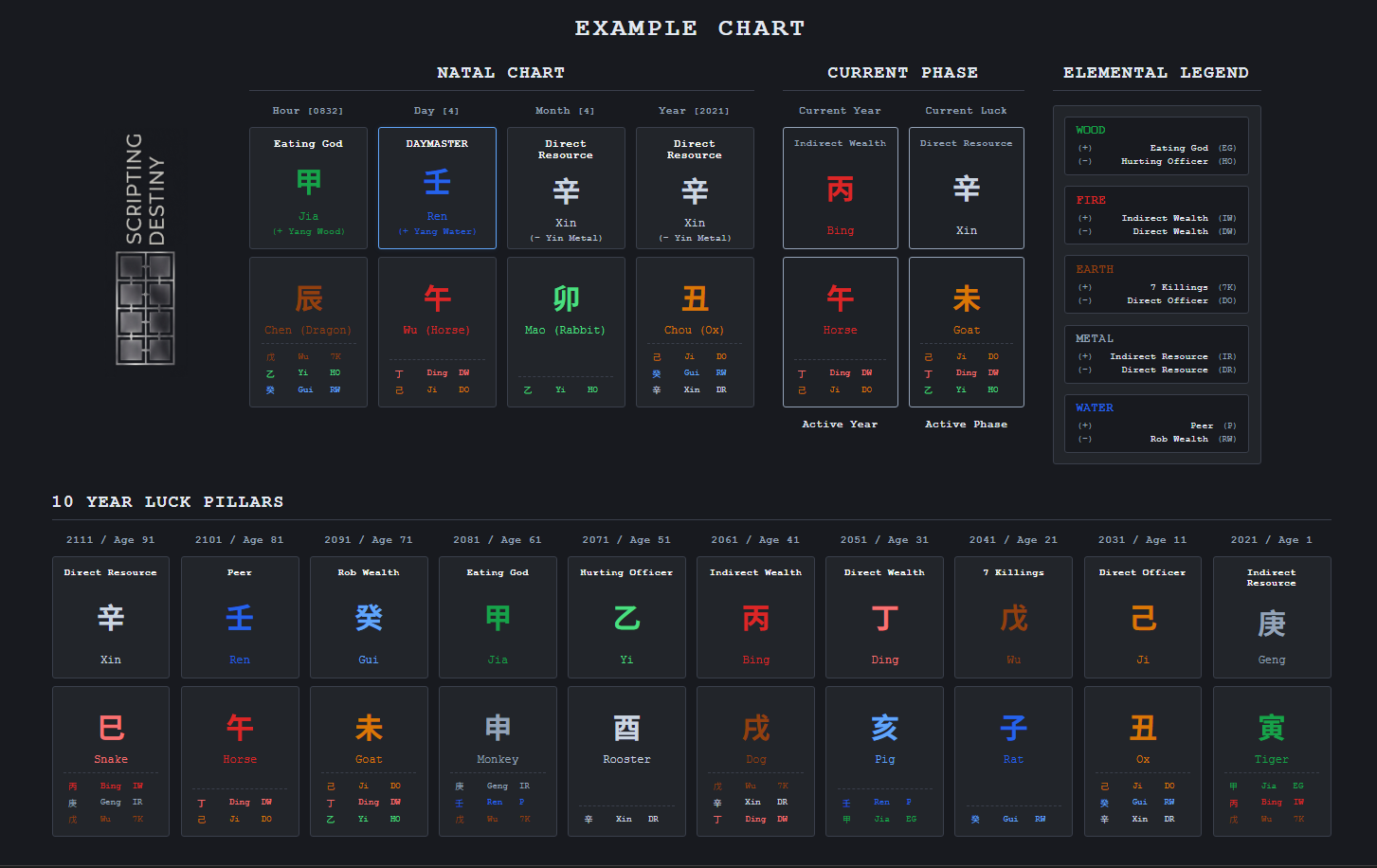
If you’ve ever played a role-playing game (RPG) of any sort, you know the most important part happens before the game even begins: Character Creation.
You choose a class. You establish your base stats. You allocate extra points to stats like Strength, Dexterity, and Intelligence. These numbers dictate how you will interact with the game world. A high-Charisma bard talks their way past the guards. A high-Strength barbarian simply removes the door. We accept these principles and archetypes as a core mechanic of the genre.
But what if the real world operates on a similar, highly structured set of background variables?
That’s what BaZi(八字)is. A Chinese Metaphysics system that generates a person’s “stat sheet” at birth.
Also known as the Four Pillars of Destiny, BaZi isn’t a personality test. It is a set of 8 elements determined by the Year, Month, Day and Hour a person was born. Put together in a 4x2 grid (hence four pillars), it creates a map of potential for your life.
The system worked so well for the ancients that the art spread across East Asia. You may have seen it in action on the Korean reality show Battle of Fates as Saju (Four Pillars), or heard about Shichū Suimei (Deducing Destiny by the Four Pillars) in Japan. The Vietnamese know it as Tử vi Tứ Trụ (Astrology of the Four Pillars).
It is common for people in Asia to consult masters with their birth info, and use the information to make major life decisions. The most successful masters often consult for conglomerates, and their advice can factor into corporate decisions made by CEOs.
Contrary to popular misconception, BaZi is not a mystical fortune-telling tool. It is a map of your cognitive baseline.
Just like an open-world RPG, how you navigate your environment depends on how your base stats process information. For example, a chart with a hyper-active 'Output' structure doesn't just mean you are creative. Psychologically, it operates much like a hyperactive attention span - brilliant, but difficult to focus. Similarly, an overloaded 'Earth' structure can manifest as severe executive dysfunction, trapping the player in analysis paralysis.
Using BaZi to understand our cognitive baseline and how we can manage them to achieve real world outcomes is where we can start scripting our own destiny.
Deriving Your Base Stats
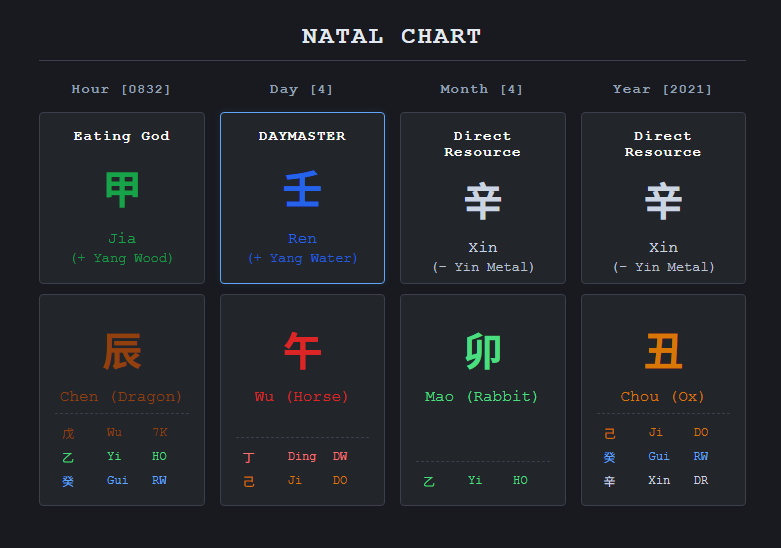
To understand BaZi, we have to strip away the pop-mysticism and look at its foundational manuals. Texts like the Zi Ping Zhen Quan (子平真诠), or The True Interpretation of Zi Ping, don’t read like magical grimoires. They read like technical documentation for a complex system, with logic trees and if/then/else as well as and/or rules for reading a chart. In other words, the game’s underlying ruleset or code.
At the exact moment of your birth, the universe was running a specific “build” of time and space. BaZi translates the year, month, day, and hour of your birth into an eight-character base stat matrix. This matrix represents the elemental variables present when your unique campaign began.
In RPG terms, the universe is a Dungeon Master (DM) who has determined what your base stats are according to its ruleset. The DM has also planned out the general outline of your life’s campaign, determining what kind of energetic weather and terrain you’ll encounter along the way.
You are the player. It is up to you to figure out what to do with those stats and how to navigate the environment you find yourself in. You can choose to optimize your build, compensate for your weaknesses, and make strategic efforts to get the best ending possible. Or you can choose to simply roll the dice and accept the easy “average” ending. Choose to ignore the limits of your stats, or make reckless decisions in a hostile environment? Then it’s the bad ending.
Elemental Dynamics: More Than Just “Magic”
In gaming, elements are usually just damage types - fire burns, water freezes. In BaZi, as outlined in the legendary Di Tian Sui (滴天髓), the Five Elements (五行) are actually fundamental kinetic forces. They are the physics that govern how your specific character sheet interacts with the world.
Instead of “luck,” think of these as Elemental Dynamics:
Wood: The force of growth, expansion, and networking. It represents outward momentum, bending and adapting as it does so.
Metal: The force of structure, boundaries, and execution. As the classics note, Metal is unyielding but moldable - once forged, it cuts through noise to establish order.
Fire: The force of illumination, transformation and destruction. It makes things visible, its expression restless and rapid.
Water: The force of flow, data accumulation, and adaptability. It finds the path of least resistance, governs wisdom and stores deep information.
Earth: The force of storage, stability, and buffering. It is the base that holds the other elements in place.
Your BaZi chart reveals how these variables interact. Do you have a highly volatile Wood/Fire build that constantly seeks stimulation, requiring Water-based cooling mechanisms like meditation or deep focus to regulate your behavior? Or do you have a rigid Metal/Water structure prone to analysis paralysis, requiring the external Fire of a scheduled public performance to initiate action?
The 10-Year Patch Cycle: Surviving the “Da Yun”
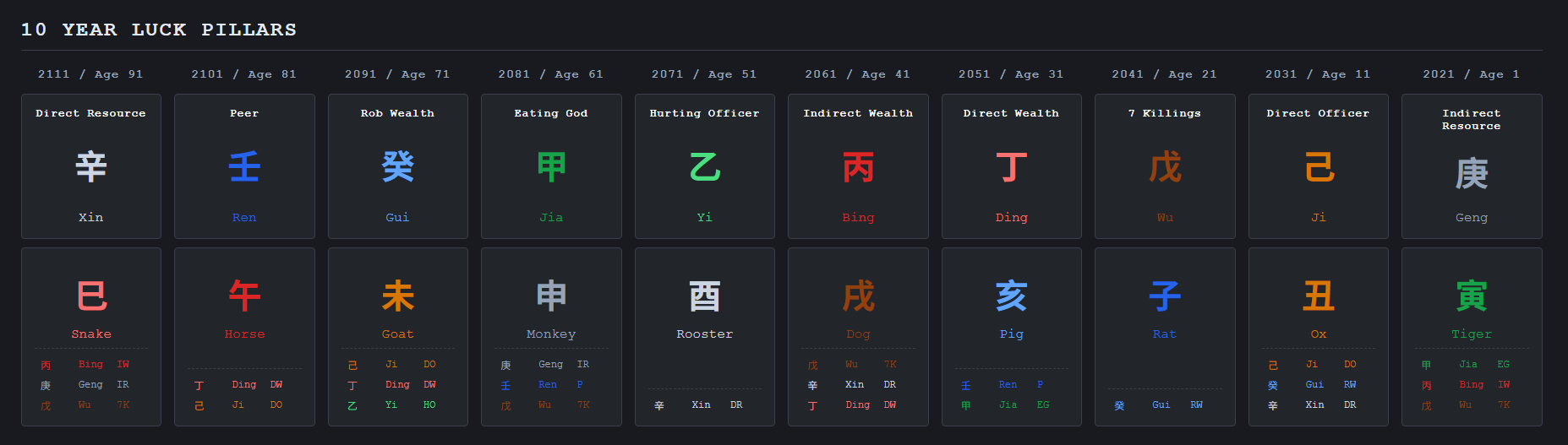
These are patches from the universe that changes the meta of your life, or a new environment that your DM has put you in. In a tabletop campaign, your character eventually moves from one environment to another. An enchanted staff that worked perfectly in an open forest becomes a massive liability in a cramped, underground cavern. A stealth skill that was useless in a bright, open desert becomes a lifesaver when you enter a crowded, shadow-filled city.
In BaZi, this change in energetic environment is called your Da Yun (大运), or 10-Year Luck Pillars.
The San Ming Tong Hui (三命通会), or The Comprehensive Book of the Three Destinies, makes it clear. The cognitive baseline of your natal chart is static, but your Da Yun is dynamic. Every ten years, the campaign setting shifts, and the elemental environment around you changes.
This isn’t about “good luck” or “bad luck.” It is a shift in the cosmic weather. A specific 10-year pillar might introduce heavy Water elements - the kinetic force of data accumulation and fluidity - into your life. If your cognitive baseline lacks the structural boundaries to contain it, this sudden influx of Water will systematically flood your chart.
Psychologically, this manifests as extreme analysis paralysis, overwhelming anxiety, and a complete loss of operational focus. You find yourself drowning in endless options and overthinking, unable to execute or hold your ground. Instead of a period of smooth advancement, the campaign difficulty spikes, plunging you into a frustrating environment where your primary objective shrinks from strategic expansion to mere cognitive survival.
Under such circumstances, it is unlikely that any major success can be achieved, fulfilling the “prediction” of working hard for little gain in the classical texts.
Unlike a video game, the simulation doesn’t guarantee you a balanced experience. Because the 10-year patches move in massive, sequential blocks, you might face a 30-year run of hostile energetic environments. There is no cosmic guarantee that ‘good luck’ is waiting around the corner.
But this is exactly why you need to understand the rulebook. When you understand your chart’s psychology and how it reacts to external events, a harsh cycle isn’t a mysterious curse. It is a known environmental hazard.
If you know you are entering a 10-year pillar that starves your system of resources, you don’t wait for the DM to ‘reward’ you with fortuitous encounters. You artificially introduce those resources yourself and time major decisions for favorable periods within the decade. You change your industry, you alter your environment, and you deploy the exact elemental strategies required to keep your character advancing until the campaign setting changes again.
Playing the Meta: Strategy Over Fortune
This is where the paradigm shifts. When you understand your BaZi chart through the lens of data, classical mechanics and how they affect your psyche, you stop asking fortune-teller questions like, “Will I be rich?” or “When will I find love?”
Instead, you start thinking like a strategist:
“Is the current 10-year meta favoring my build?”
“What elemental resources do I lack? How can I generate and introduce them into my environment?”
“If my current patch makes aggressive expansion highly risky, should I pivot to resource gathering and defense for the next three years?”
BaZi isn’t about surrendering to a pre-written fate. It’s about reading the campaign module ahead of time and preparing to leverage it or adapt. It is the original character sheet, designed to help you navigate the environment, optimize your build, and ultimately, script your own destiny.
Enjoyed the article? Journey with me, get access to case studies of how destiny manifests in real life, and learn to script your own destiny.
Disclaimer: Scripting Destiny explores classical BaZi as a structural framework for personal strategy. The content provided here is strictly for informational and educational purposes, and does not constitute professional financial, medical, or legal advice. You are the Admin of your own life; make your decisions accordingly.